Some musical theater numbers announce themselves with lights, choreography, and a stage full of bodies. Me and the Sky does almost the opposite. It asks us to lean in. The power of the moment is not that it overwhelms the room, but that it trusts a story, a voice, and a few carefully chosen details to do the lifting.
That is why this Come From Away clip is such a strong Big City Broadway moment. It captures one of the best things musical theater can do: take a life that could have been summarized in a paragraph and let it become immediate. Suddenly we are not hearing a biography. We are watching someone remember who she was before the world changed, who she had to become, and what it cost to keep moving.
Why It Works
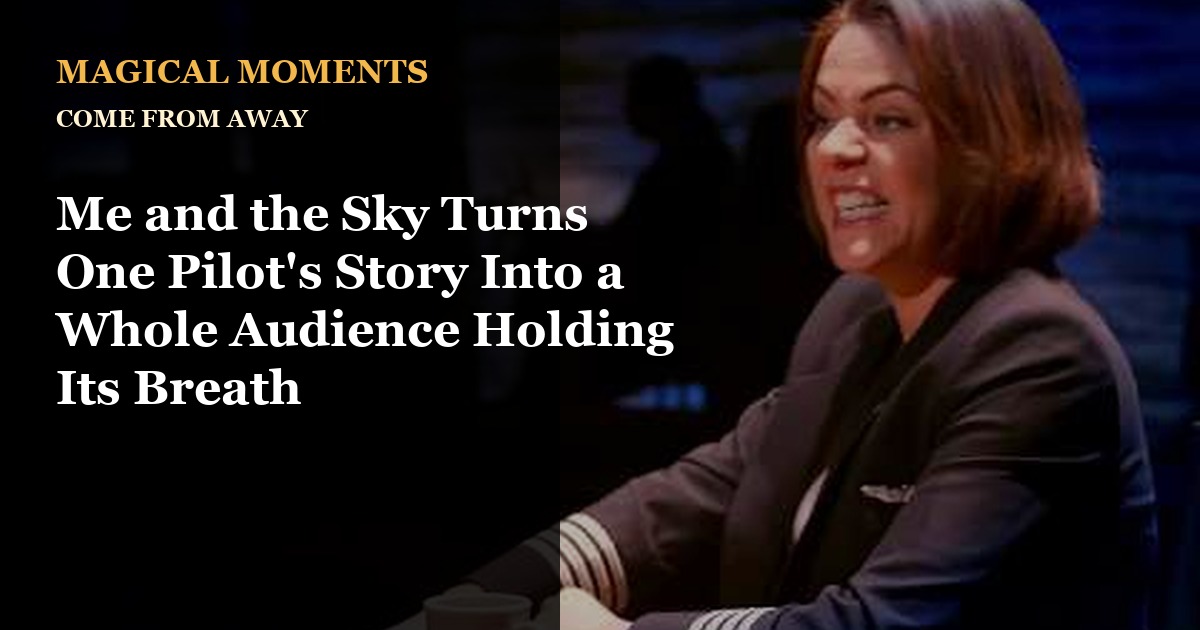
Come From Away has always been a musical about motion: planes diverted, strangers arriving, townspeople rushing, lives colliding. Me and the Sky pauses that motion just long enough to let one person step forward. The number follows Beverly Bass, the pioneering pilot whose story gives the musical one of its clearest emotional arcs. Even if a viewer does not know every detail going in, the structure is easy to feel. A kid looks up. A dream forms. A career rises. Then history interrupts everything.
What makes the song compelling is how naturally it moves between pride and grief. It does not treat achievement as a glossy inspirational poster. It lets the joy of flying sit beside the shock of September 11, and it refuses to make either feeling simple. That emotional honesty is what keeps the performance from becoming a standard “big solo.” It has lift, but it also has weight.
The staging helps because it understands restraint. A performer in uniform can suggest an entire cockpit. A chair can become a memory. A small shift in posture can carry years. This is theater using suggestion as a strength, not a limitation. The audience fills in the sky because the performer gives us enough truth to imagine it.
What to Watch For
Watch the way the performance builds without rushing. The early moments often feel conversational, almost casual, as if someone is telling a story across a table. Then the musical line begins to climb. The rhythm tightens. Details accumulate. By the time the number reaches its emotional peak, the audience has been carried there step by step.
That gradual climb matters. It mirrors the life being described. There is no instant transformation. There is discipline, ambition, resistance, luck, work, and then a day no one could have prepared for. The song lets us feel both the individual journey and the larger historical shadow around it.
It is also a reminder that Broadway magic does not always require fantasy. Sometimes the magic is recognition. We recognize what it means to love a calling. We recognize what it means to have pride in work. We recognize how quickly ordinary life can split into before and after.
Watch the Clip
Why People Share It
This is the kind of clip people send to someone with the note, “You need to hear this.” Not because it has a gimmick, but because it feels generous. It gives viewers a complete emotional experience in a few minutes. You can know nothing about Come From Away and still understand the stakes.
For theater fans, the number is also a great example of how modern musicals can tell true stories without flattening them. It is respectful without being stiff, moving without being manipulative, and specific enough to avoid feeling generic. It honors one person while quietly pointing toward many others: pilots, passengers, families, first responders, and the communities that had to respond to the unimaginable.
That balance is hard to pull off. When it works, it reminds us why musical theater remains such a powerful storytelling form. A spoken monologue might explain what happened. A song can let us feel the altitude, the ambition, the fear, and the silence afterward.
The Big City Broadway Takeaway
Me and the Sky is not just a showcase number. It is a compact emotional flight path. It starts with wonder, rises through determination, and lands in a place where pride and sorrow have to share the same seat. That is why the clip stays with people.
Big City Broadway exists for moments like this: performances that make someone stop scrolling because the human feeling cuts through. This one does not need a giant set piece to be unforgettable. It has a story worth telling and a performer trusted to tell it.